

I’ve been asking myself this as more powerful AI takes over more of my work. I’m in awe of what it produces, and yet I keep noticing a quiet dissatisfaction I can’t quite put my finger on. The artifacts are real. My role in producing them feels less so. What does that mean for me?1
Over the past five years, I’ve been working on Flow Club. The mechanism is almost embarrassingly simple — a group workout class, but for any kind of work. Members sign up for a session, briefly share what they’re working on, then put their heads down and work alongside each other for a fixed time. We’ve powered over 500 years of focused flow this way and helped members check off millions of tasks: dissertations finished, jobs applied for and gotten, products shipped, taxes done, inboxes finally tackled.
And yet I’m not sure any of it matters in the age of AI. Flow Club and AI compete for the same job of reducing friction to starting tasks. The dread of the empty page, the vague goal, the insecurities: AI just walks around all of it. Type a semi-coherent prompt and the model runs right past the starting barrier, smooths out the unsavory in-between, and comes back with output close to (and sometimes better than) what you’d have made yourself. Something like Flow Club stands no chance. It’s like Weight Watchers in the age of Ozempic.
The task initiation bundle
The simplistic view of a task is that the goal is upstream of the doing. You have a goal, then you do the work. This is also how AI is trained. But in reality, the doing is often how you find and clarify the goal. Having worked alongside thousands of Flow Club members, that’s the pattern I see — people rarely start with full clarity about what they’re doing. The clarity comes once you really start.
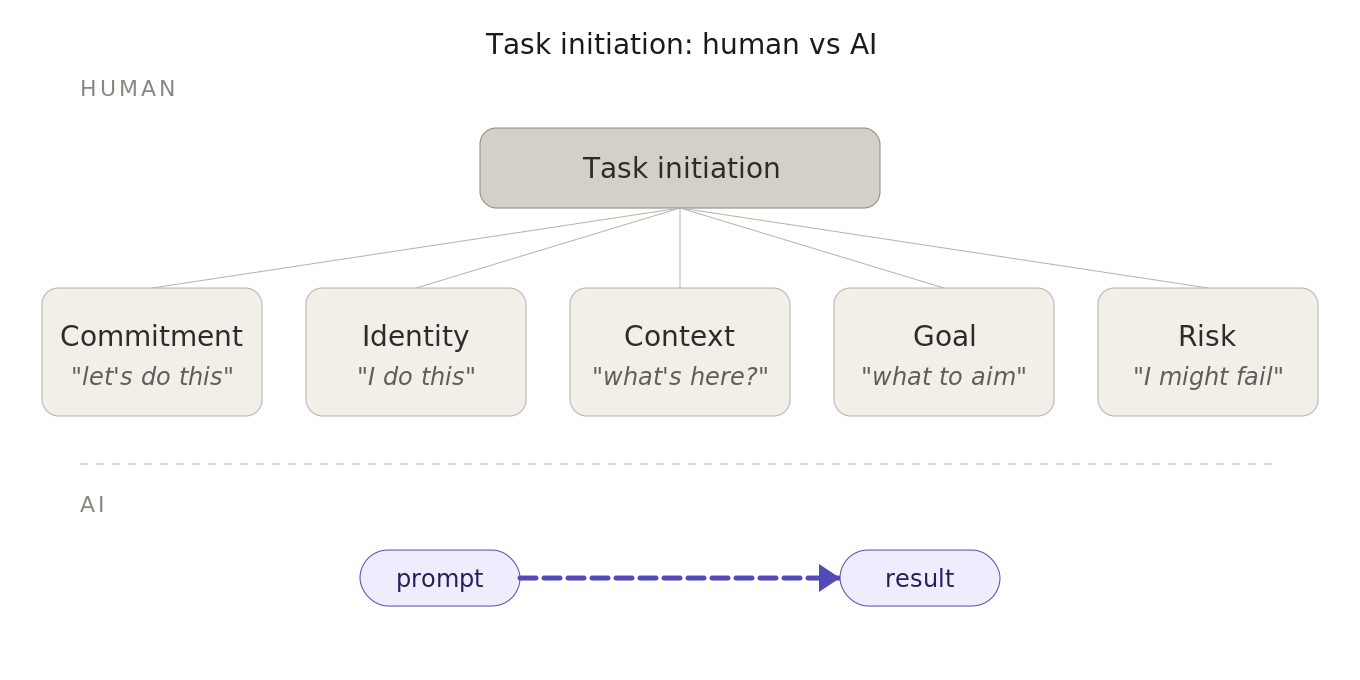
Task initiation isn’t just a matter of getting started. It’s a bundle that includes energetic commitment (“let’s do this!”), identity assertion (“I’m the kind of person who does this”), context-loading (“what do I know, what’s on the table”), goal formation (“does my goal still make sense given what I just loaded in”), and a quiet risk-taking (“I’m not sure this’ll work, but I’m doing it anyway”). Initiating a task is initiating investment. And the investment is what creates meaning.
Why AI flips the productivity script
When you delegate task initiation to AI, the bundle doesn’t get reproduced — it gets bypassed. The classic productivity wisdom is “the hard part is starting; momentum carries you home.” AI flips that. Starting becomes free, but finishing gets harder, because you’re dissociated from the work. You have to take ownership of context you didn’t build and decisions you weren’t privy to — like a passenger being asked to land an airplane. It’s harder because the work is not quite yours.
This, I think, is why so much excitement about AI runs alongside a quiet dread. Christina Maslach, whose research underlies the WHO’s official definition of burnout, has long argued that burnout comes not from overworking but from a gap between what you do and what feels meaningful to you.2 AI delegation can create that gap by dissociating us from our work.
The median output trap
There’s a reasonable counterargument: isn’t there value in cognitively cheap task exploration? You can use AI to traverse a dozen paths in minutes and figure out what you actually want. True. But it’s also true that AI tends toward median outputs. The median rendering of a great idea looks identical to the median rendering of a regular one. When you strain to produce mediocrity yourself, you naturally think, “I haven’t nailed it yet.” When AI produces the same mediocrity from your idea, you’re more likely to assume your idea sucked and abandon it prematurely. We risk letting AI shortcut the inspiration that sustains the perspiration on the way to great work.
What I actually want from AI
For tasks we don’t want to invest in — and that’s most tasks — delegating to AI is the right answer. I want model progress to keep accelerating so we can offload more of those. But for the tasks that mean something to us, I don’t think we should dissociate so easily. This isn’t about doing it the hard way for its own sake. It’s about how AI can add to, and not strip away, what it means to be a productive human.
A worked example: how I wrote this
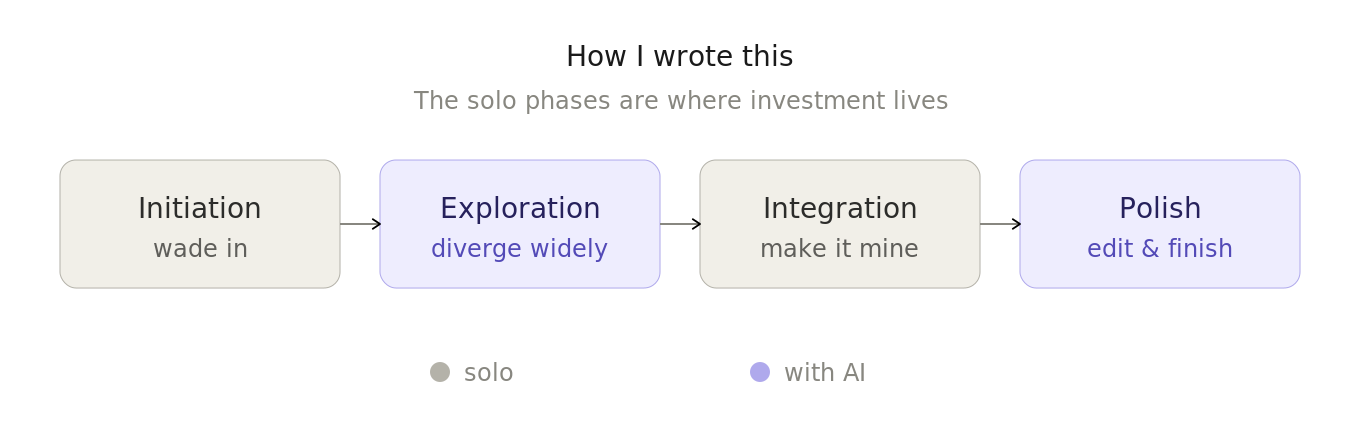
My process for writing this essay might be instructive. I drafted my own thoughts first.3 Then I asked Claude to talk to me about what I’d written — it gave me tighter frames, pulled me toward a wider aperture than what I had in mind, and surfaced conclusions I hadn’t yet reached. I rejected some of it, incorporated others, then closed the chat to re-integrate everything into something that still felt like mine. Once I had a draft I was happy with, I came back to Claude to edit and polish. The shape was: solo task initiation → AI thought partner → solo integration → AI editor.
I was tempted to skip the solo, frictionful phases and simply pick from a menu of AI-generated artifacts, but I likely would’ve abandoned the piece if I had. I didn’t, because I fiercely defended my ability to claim this piece as my own.
Why building for humans still matters
Today’s AI can be a seductive crutch. It’s eager to take tasks off our plates, and we’re happy to let it. But if we’re not careful, we delegate more than tasks. We delegate the chance to invest in them — and the meaning that follows.
I’m excited about a future where AI is also invested in our fulfillment. AI that helps us discern what’s worth investing in. AI that knows when to step back and let us cook. I want products that protect the moment when we decide a task is ours, and support us in choosing the frictionful path.
Imagine doing this work alongside other humans on their own journeys — witnessing each other’s risk-taking, inspired by each other’s investments. There’s something powerful to that collective courage. It’s why startups are easier to start in Silicon Valley where everyone else is starting one too.
Flow Club is one early version of this. There will be more like it. As AI gets capable enough to do almost anything we ask, the parts of work where we come alive — the wanting, the doing, the owning — won’t disappear. They’ll just become more valuable. And the products that hold space for the friction will be some of the most important things we can build.
Footnotes
- My co-founder David has called this feeling creeping ennui — writing more code than ever with AI, and feeling more disconnected from it.
- Maslach’s framework — foundational to the WHO’s ICD-11 definition of burnout — identifies six person-job mismatches that produce burnout: workload, control, reward, community, fairness, and values. The popular “burnout = overwork” story only captures the first.
- After reading Chris Yeh’s “Use AI For Productivity, Not For Feeling Productive”, which inspired me to write this in the first place.

